

Product Applications

Application KDK's foil is utilized in products within the Chemicon Group, among others.
Usage of KDK Foil
1.Aluminum electrolytic capacitors
Capacitors are electronic components that store and release electricity by utilizing the phenomenon of charge accumulation between electrodes that sandwich an insulator. Electrolytic capacitors function as capacitors by forming a dielectric oxide film on the surface of the electrode foil through anodic oxidation and bringing it into contact with an electrolyte or solid electrolyte. Among them, those using aluminum and electrolyte are called aluminum electrolytic capacitors. There are also aluminum capacitors that divert the same mechanism and use solid electrolyte as similar products.
The capacitance of a capacitor can be obtained by the following formula:
Capacitance of a capacitor

ε: Relative permittivity of dielectric material
S: Area of counter electrode (㎡)
d: Distance between electrodes = thickness of dielectric (m)
From the above equation, the capacitance of a capacitor increases in proportion to the dielectric constant of the dielectric material and the area of the counter electrode.
Aluminum electrode foil, the counter electrode of aluminum electrolytic capacitors, can be etched to increase its surface area, thereby increasing its capacitance.
Structural Diagram of Aluminum Electrolytic Capacitors
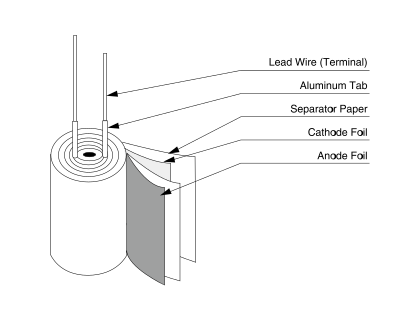
Figure 1: Device Structure of Aluminum Electrolytic Capacitor
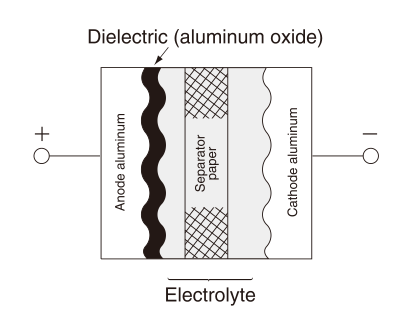
Figure 2: Basic Diagram of Aluminum Electrolytic Capacitor
Figures 1 and 2 above show the structure of aluminum electrolytic capacitors.
- Our electrolytic foils are used as the anode and cathode aluminum foils shown in Figure 1.
- The actual counter electrodes are the anode foil and the electrolyte, and the film formed on the surface of the anode foil serves as the dielectric (see Figure 2).
- The larger the area of the counter electrode in an aluminum electrolytic capacitor, the higher the capacitance.
- The surface area of aluminum electrolytic foil has a great influence on capacitance, which is the most basic and important performance of aluminum electrolytic capacitors, the component that stores electricity.
- Our surface area expansion technology (etching) and dielectric film generation technology (Forming) will contribute to higher performance of aluminum electrolytic capacitors.
2.For coating substrates (EDLC, LiB, etc.)
In recent years, a wide variety of batteries, mainly LiBs, and energy storage devices, such as EDLCs (electric double layer capacitors), exist.
These devices differ from capacitors in their principle of operation, and the surface area of the aluminum foil does not directly correlate to capacitance performance.
However, our aluminum electrode foil can be used as the electrode base metal foil for products such as LiB and EDLC, where the electrode is manufactured by coating powder material on a
metal foil.
EDLC Structure

Figure 3: EDLC Structure
EDLC activated carbon electrodes use active materials such as activated carbon coated on the surface of the metal foil that serves as the electrode base material.
By using an etched aluminum electrode foil as the electrode base material, the unevenness of the foil surface improves the coating application and may provide an advantage in coating
strength compared to a flat base material.
Similarly, it may be used as a base material for LiB cathode electrodes (Aluminum is bipolar and may corrode when used as a base material for the negative electrode).
3.As a porous metal
Our aluminum electrode foils are basically optimized for aluminum electrolytic capacitors.
On the other hand, it is a unique product with many pits on the foil surface, a pit structure for AC etching, and a tunnel structure for DC etching.
Furthermore, insulator film can be produced by Forming, and application is up to the customer's conception. The possibilities are endless.
Please feel free to contact us using the inquiry form.